


Print article
Authors
Article:
This article was first published in AgriLore Summer 2026. To explore the full edition and related insights, click here.
Artificial Intelligence (AI) has the potential to transform the farming industry, from improving crop yields, mitigating labour shortages and enabling farmers to operate in a more sustainable manner. Understandably, businesses in this industry are looking to expand their use of the technology.
We regularly advise our clients regarding how to deploy AI safely and how to manage the associated legal risks.
In our AgriLore Summer 2025 Edition, we reported on how technology is helping to deliver the farming of the future, and in this article, we have taken a closer look at specific use cases for AI in farming, and the associated legal challenges to be aware of.
Managing farm animal welfare
The innovation:
Early detection of disease is crucial in maintaining the welfare of farm animals and reducing the likelihood of illness spreading through a herd. Machine learning algorithms can be used to monitor continually and analyse the footage obtained from sensors and live video feeds, to more accurately identify subtle changes in animal behaviour, posture and activity levels that might indicate illness or distress. For example, farmers can pre-define scenarios that they want the AI to alert them to, such as whether cows are lying down enough and when food or water is running low. This allows for prompt intervention.
The legal challenges:
- Confidentiality: AI tools use content provided by users to train their models, meaning information that is input can later be included in output for another user. This raises particular concerns if a farmer’s confidential information is input, as this could result in commercially sensitive information being unintentionally shared. For example, if a farming business has developed a tool or machine that gives an advantage over competitors, it will not want images of that technology being processed and shared with other users of the AI tool.
- Cyber security: The processing of increased amounts of data risks cyber criminals targeting the food and agriculture sector. Farmers will need to invest in the infrastructure required to protect against such threats.
Pest and weed control
The innovation:
AI can be used to analyse soil and crop data in order to identify weeds amongst crops with high precision, allowing for targeted application of fertilisers and pesticides through robotics and lasers (instead of blanket applications). This targeted approach reduces costs and environmental impact, and promotes healthier crop growth by preventing over-application, which is harmful to plant and soil health.
The legal challenges:
- Liability: Some AI systems are vulnerable to generating “hallucinations” (misleading or wrong results). In the case of pest and weed control, such oversights could result in the AI tool making the wrong decision regarding the administration of pesticides, leading to the unnecessary destruction of good crops. A further risk is that the AI model could recommend the application of a pesticide at a concentration that violates agricultural laws and regulations. In these instances, the farmer will likely want to seek compensation against the AI provider. As reported in our article “Navigating the legal risks as a business using Artificial Intelligence”, the terms and conditions offered by the providers of AI tools often significantly limit their own liability and place the risk on users of the platform. Businesses therefore need to consider and negotiate carefully the contractual terms offered by AI service providers.
- Job losses: Farmers may find that the use of AI and robotics reduces the need for manual labour, resulting in considerations regarding how to manage their existing workforce.
Automated picking
The innovation:
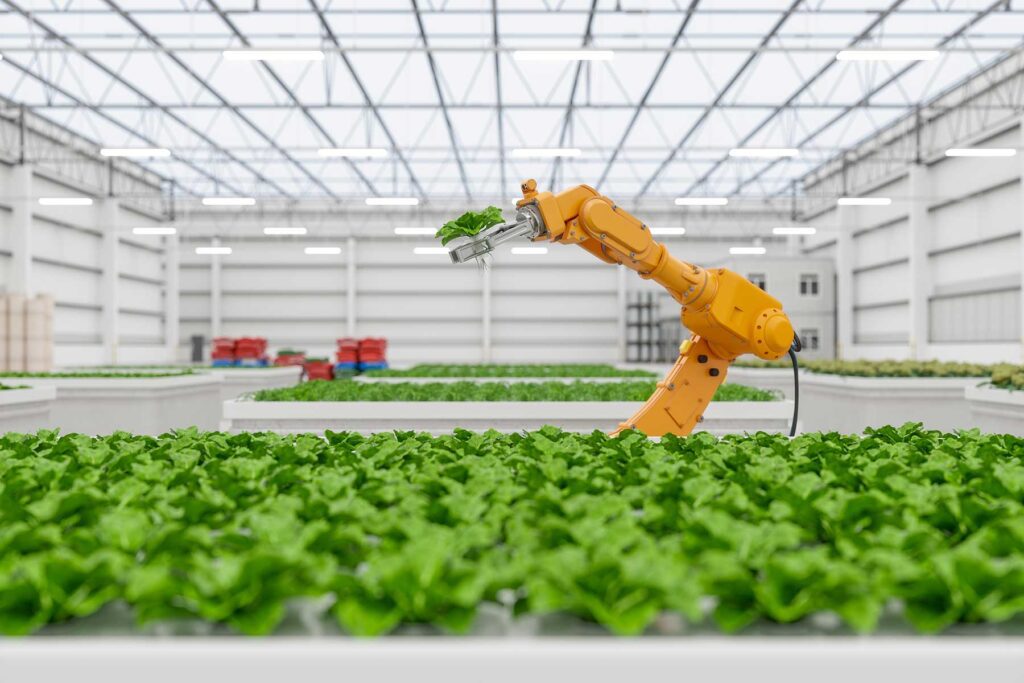
The innovative business Dogtooth uses robots equipped with a variety
of sensors, including cameras and depth sensors, to allow the robots to see, understand, and interact with soft fruit in real time. This enables the efficient harvesting and grading of picked berries.
The legal challenges:
- Data privacy issues: Whilst most of the data captured through the sensors of such robots will not capture humans, the personal data of individuals such as employees working on the farms may be captured (particularly through any video feeds) and processed. Businesses using these farming techniques will therefore need to ensure that they are complying with obligations pursuant to data protection legislation in doing so.
Weather predictions
The rise in unpredictable weather as a consequence of global warming means that farmers are finding it increasingly challenging to manage their land. AI can analyse weather data to provide accurate weather predictions, enabling farmers to schedule seed planting and watering cycles.
The legal challenges:
- Bias: AI tools are a product of the data used to train their algorithms. This means that the tool can have biases based on the dataset that is used. For example, recommendations as to watering cycles may be based upon data from a certain geography, which may not be applicable to the particular use case. AI tools may also be trained on data that disproportionately reflects large-scale farming operations, leading to recommendations that are not beneficial to smaller farms (risking increased costs for smaller farmers in doing so).
Key takeaway
The ground-breaking efficiencies that AI can create in this important industry must be carefully balanced with the potential challenges. Well-advised farming businesses will implement measures to mitigate such risks, before deploying this technology.